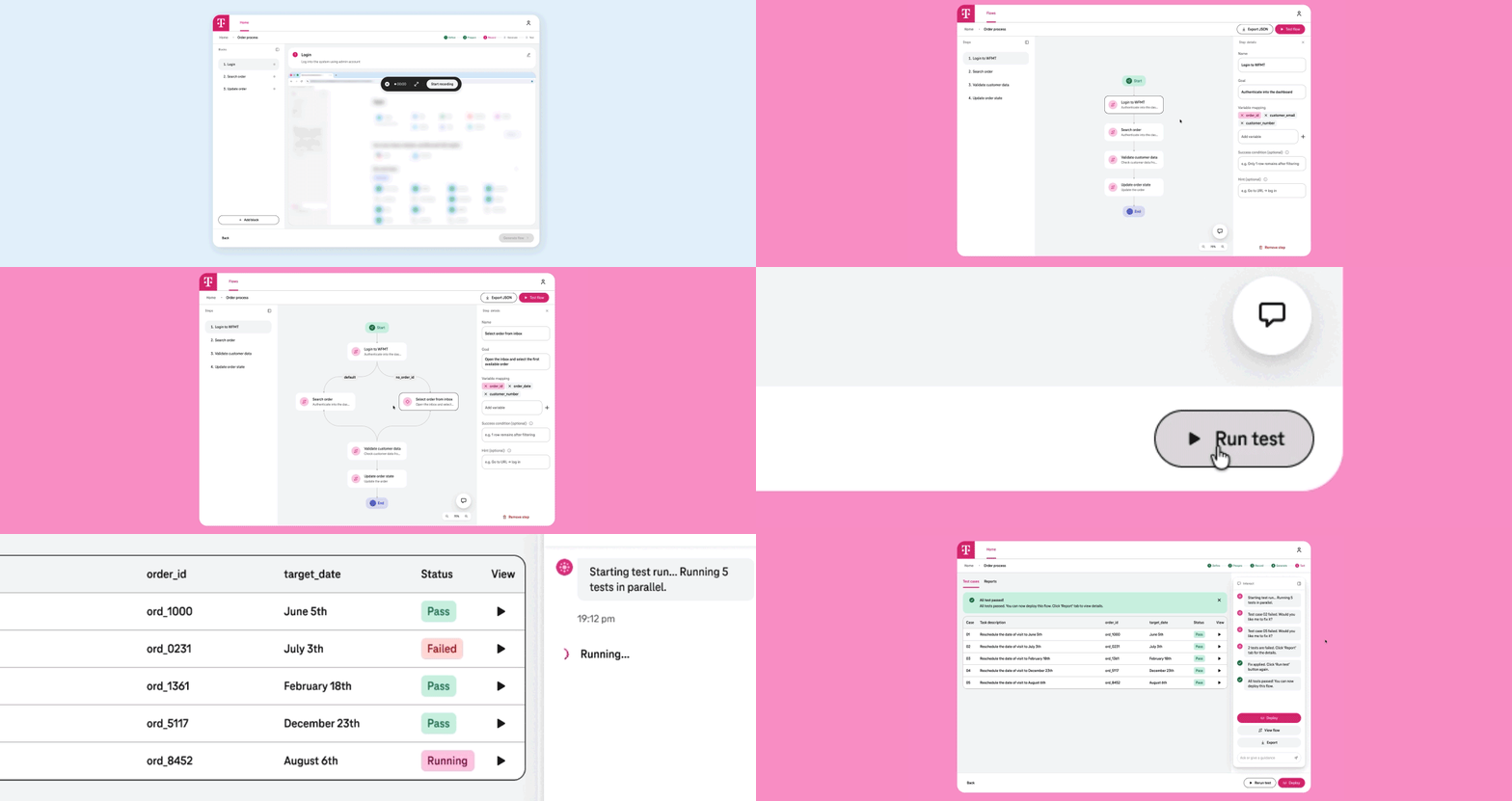
Teaching AI Through Demonstrations
Designing a system that turns expert task demonstrations into AI-executable workflows.
Designing a system that turns expert task demonstrations into AI-executable workflows.
In a resource-constrained environment, I prioritised interaction model and IA over visual polish, using AI tools to speed up prototyping. 7 IA iterations aligned cross-functional teams on the core UX direction within 2 weeks.
In a resource-constrained environment, I prioritised interaction model and IA over visual polish, using AI tools to speed up prototyping. 7 IA iterations aligned cross-functional teams on the core UX direction within 2 weeks.
Timeline
Timeline
Feb 2026 - Present
Feb 2026 - Present
Platform
Platform
Responsive Web
Responsive Web
Team
Team
2 Designers (1 lead-me, 1 service design)
6 Engineers
3 AI engineers
3 Product Managers
2 Designers
(1 lead, 1 contract)
6 Engineers
3 AI engineers
3 Product Managers
Roles
Roles
Led UX for AI learning system
Defined learning interaction model
Designed recording-to-flow workflows
Built IA and contextual questioning framework
Led end-to-end AI execution UX
Defined interaction model and IA
Designed HITL workflows and logic
Drove iterations based on pilot data
Led end-to-end AI execution UX
Defined interaction model and IA
Designed HITL workflows and logic
Drove iterations based on pilot data
Why this exists
Why this exists
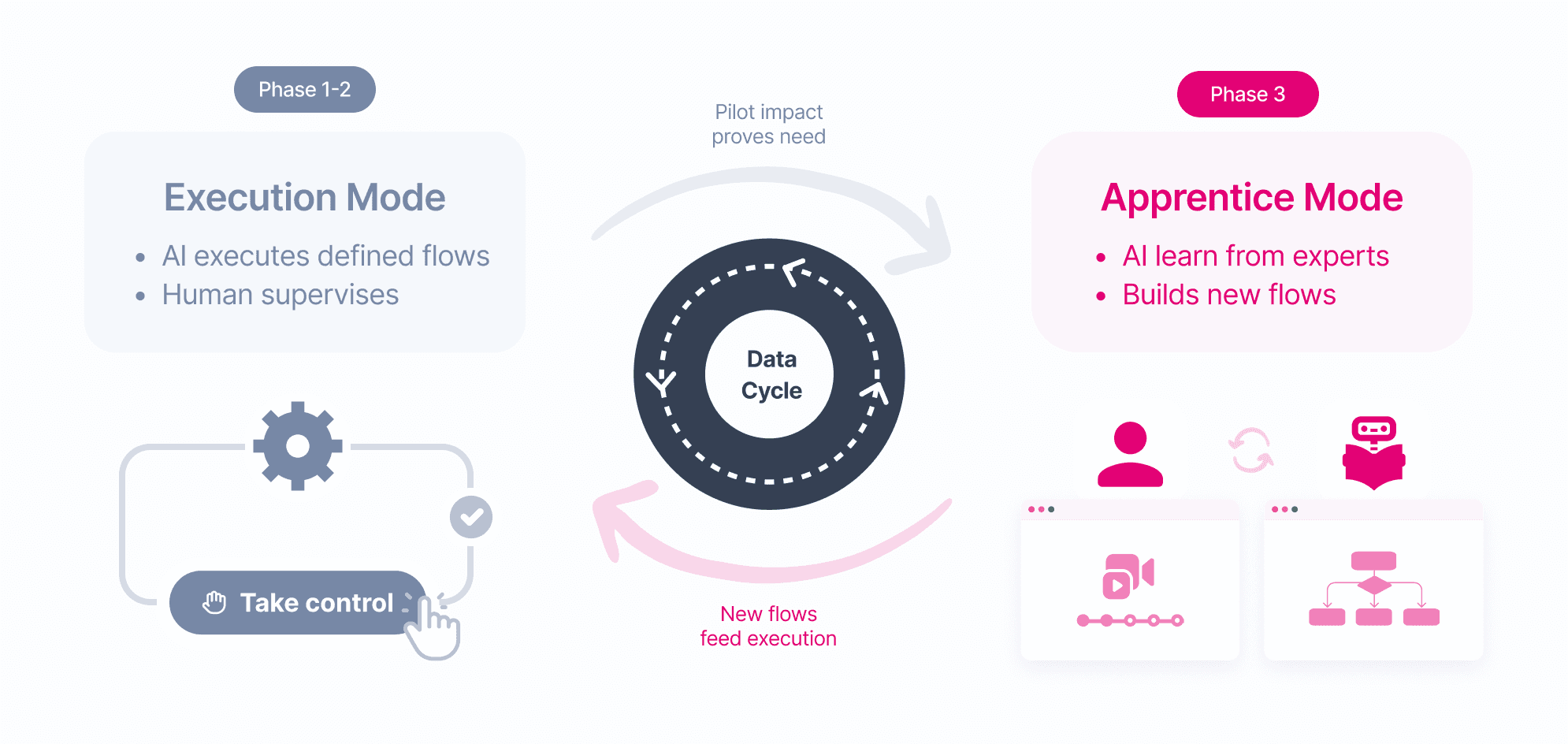
While Execution Mode proved how AI works, Apprentice Mode focuses on how AI learns.
While Execution Mode proved how AI works, Apprentice Mode focuses on how AI learns.
Execution Mode automated predefined tasks. To scale beyond this, the system needed to learn from domain experts, requiring a new interaction model to capture intent. This direction was validated through the pilot.
Execution Mode automated predefined tasks. To scale beyond this, the system needed to learn from domain experts, requiring a new interaction model to capture intent. This direction was validated through the pilot.
Challenge
Challenge
Teaching AI is more than just recording clicks. It needs to capture why someone made each decision.
Teaching AI is more than just recording clicks. It needs to capture why someone made each decision.
Solution
Solution
Designed a Recording-to-Flow learning system that enables AI to learn from user demonstrations, completing the full AI agent lifecycle.
Designed a Recording-to-Flow learning system that enables AI to learn from user demonstrations, completing the full AI agent lifecycle.
Foundation for Execution → Learning loop
Foundation for Execution → Learning loop
7× IA iterations → Kickoff within 2 weeks
7× IA iterations → Kickoff within 2 weeks
Solution
overview
Solution overview
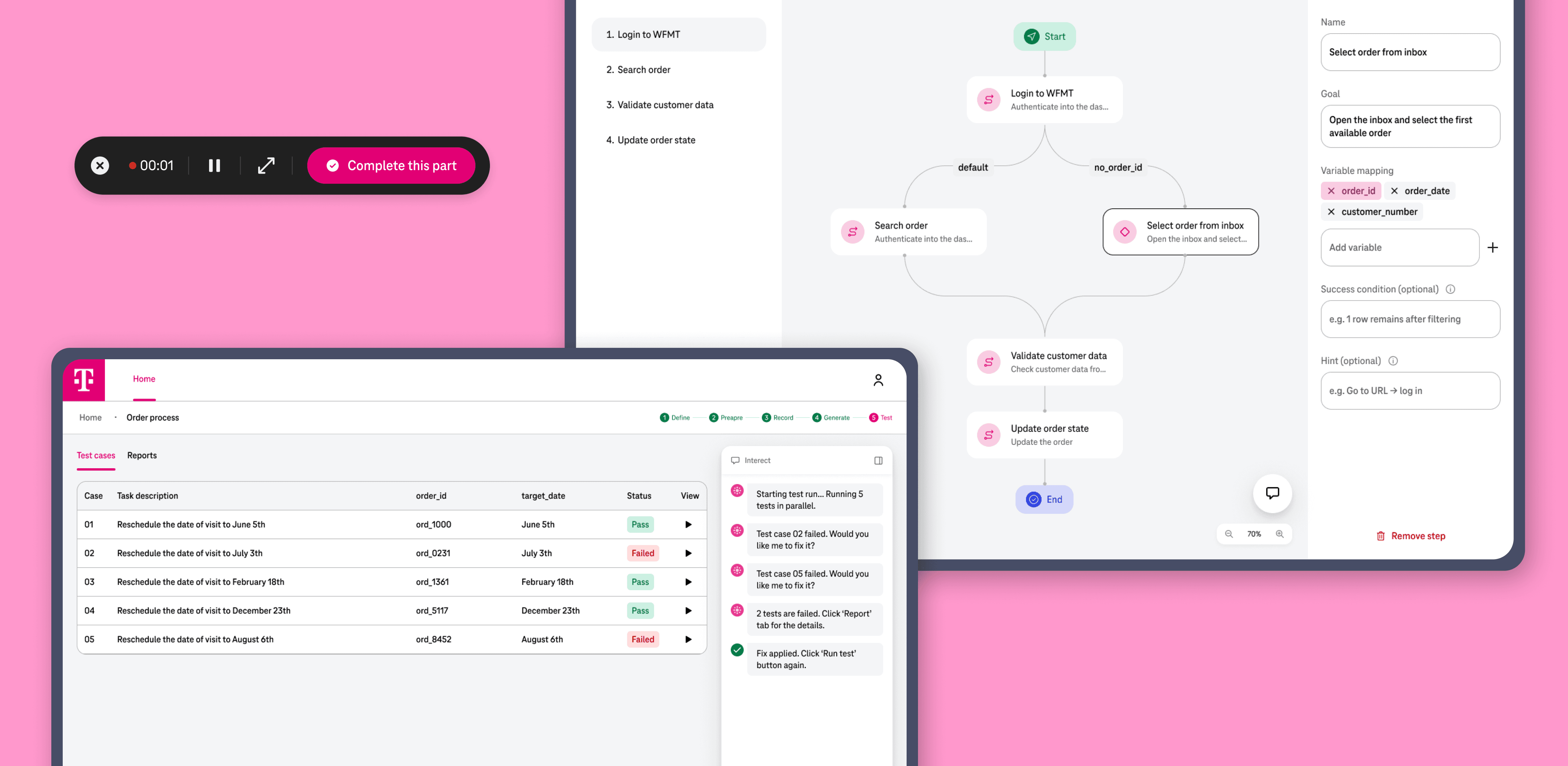
A 5-step learning pipeline turns expert demonstrations into AI-executable workflows
A 5-step learning pipeline turns expert demonstrations into AI-executable workflows
Define flow
Define flow
Big picture
Define what to teach
Prepare recording
Prepare recording
Preparation
Set scope
Record
Record
Immersion
Demonstrate the task
Generate flow
Generate flow
Understanding
Review generated flow
Test
Test
Confidence
Validate and refine
Deep Dive
Everyone understood the system differently, so I aligned the model before designing the UI.
Everyone understood the system differently, so I aligned the model before designing the UI.
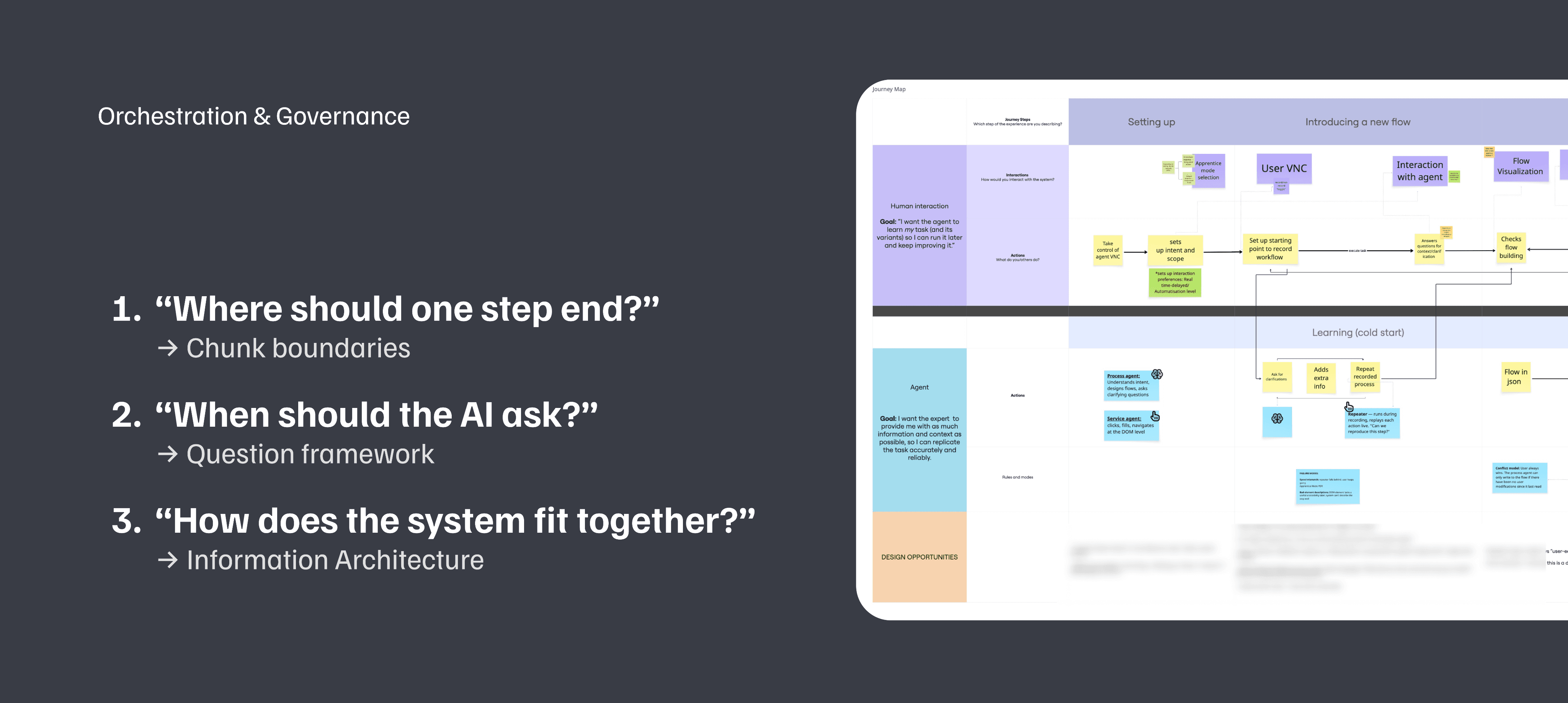
Multiple agents, steps, and human actions created conflicting mental models across teams. I used service blueprints and IA to align the system before defining how users and AI should interact.
Key Decisions
Key Decisions
① Where should one step end? → Chunk boundaries
AI learns meaningful units only when users define meaningful boundaries.
Constraint
The model performs better on short, well-defined segments than long recordings. Chunking was required to ensure high-quality training data.
What I found
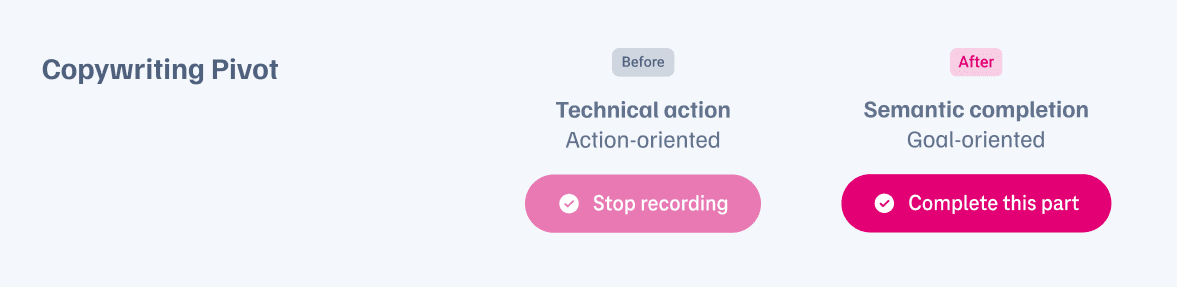
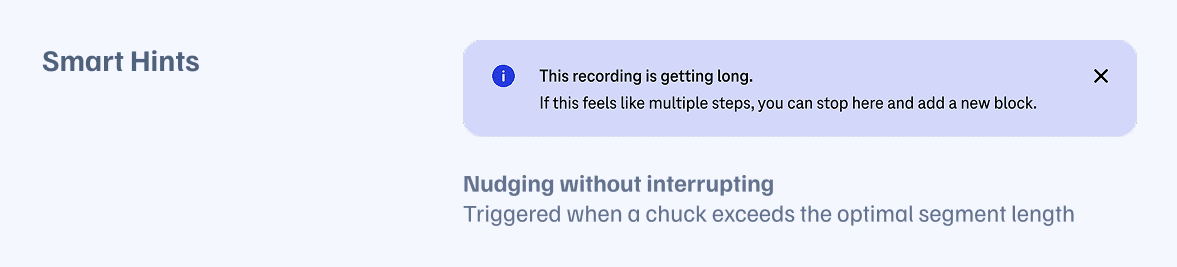
The team used a ‘Stop’ button to define chunks, but this reflects a technical action, not a meaningful step. Users pause for many reasons, yet the agent learns from every boundary.
What changed
The problem shifted from whether to split recordings to how users decide when to split. I reframed it by guiding users to define meaningful boundaries.
What changed
Development in progress · Pilot planned for Q4 2026
① Where should one step end? → Chunk boundaries
AI learns meaningful units only when users define meaningful boundaries.
Constraint
The model performs better on short, well-defined segments than long recordings. Chunking was required to ensure high-quality training data.
What I found
The team used a ‘Stop’ button to define chunks, but this reflects a technical action, not a meaningful step. Users pause for many reasons, yet the agent learns from every boundary.
What changed
The problem shifted from whether to split recordings to how users decide when to split.
I reframed this by guiding users to define meaningful boundaries.
Development in progress · Pilot planned for Q4 2026
② When should the AI ask? → Question framework
A smart apprentice knows when to ask.
Constraint
AI can't 100% grasp complex domain intent from visual recording data alone.
Challenge
The team had conflicting views on when AI should interrupt users. More questions improved context quality, but frequent interruptions broke the expert’s natural workflow.
What I defined
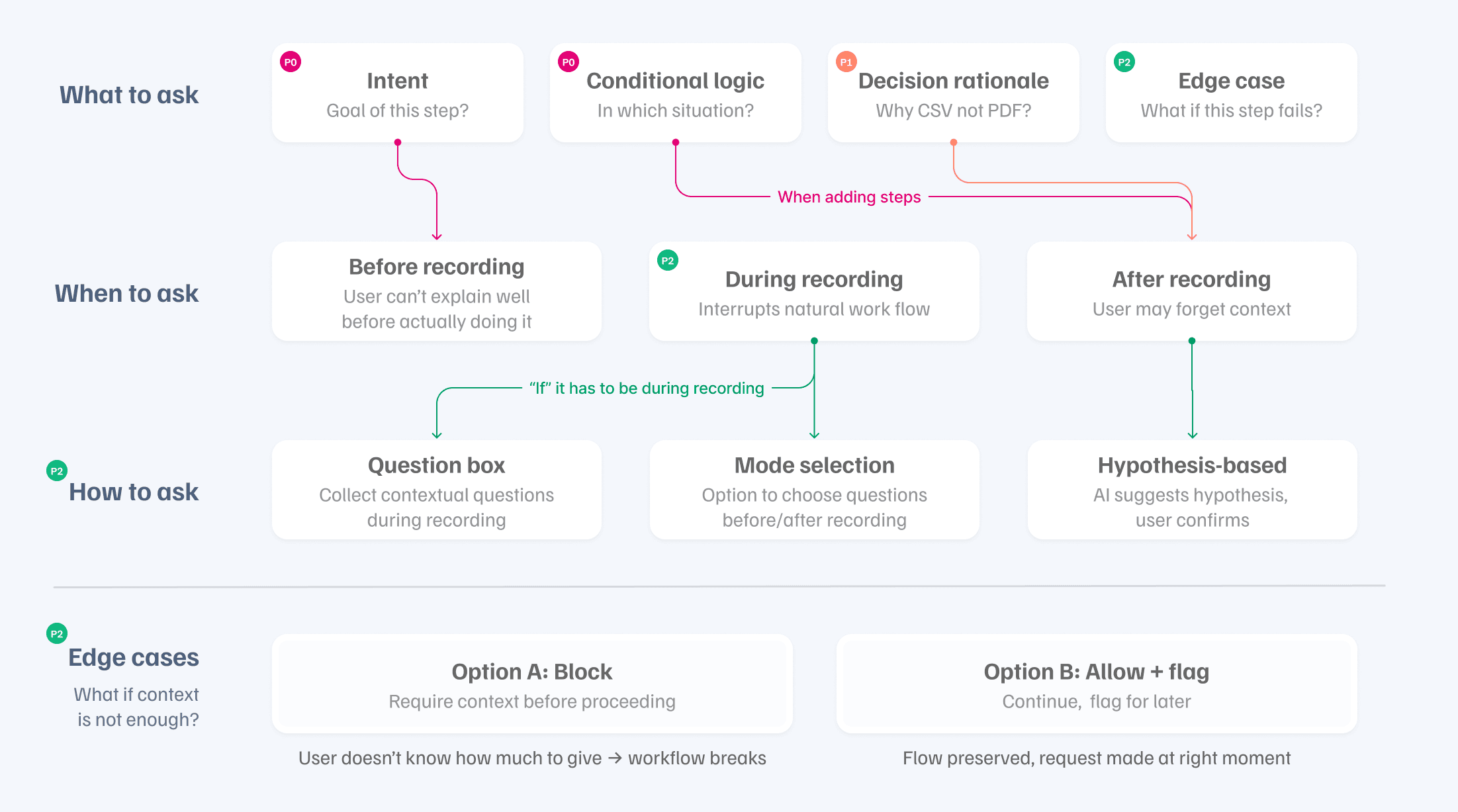
I created a contextual questioning framework to define:
a. What to ask - intent, rationale, conditions, exceptions
b. When to ask - before, during, or after the demonstration
c. How to ask - direct question, confirmation, or hypothesis
d. When not to ask - when context could be inferred reliably
What changed
The team shared one interaction policy for when AI should observe, infer, or ask, rather than letting each feature or agent decide independently.
② When should the AI ask? → Question framework
A smart apprentice knows when to ask.
Constraint
AI cannot 100% grasp complex domain intent from visual recording data alone.
Challenge
The team had conflicting views on when AI should interrupt users. More questions improved context quality, but frequent interruptions broke the expert’s natural workflow.
What I defined
I created a contextual questioning framework to define:
a. What to ask - intent, rationale, conditions, exceptions
b. When to ask - before, during, or after the demonstration
c. How to ask - direct question, confirmation, or hypothesis
d. When not to ask - when context could be inferred reliably
What changed
Instead of letting each feature or agent decide independently when to interrupt, the team had a shared interaction policy for when AI should observe, infer, or ask.
③ How does the system fit together? → Information architecture
When asked for UI within a week, I prioritised Information Architecture instead.
What I found
The team had different mental models of agents, roles, and system.
My decision
When asked for UI concepts within a week, I proposed aligning IA first.
Impact
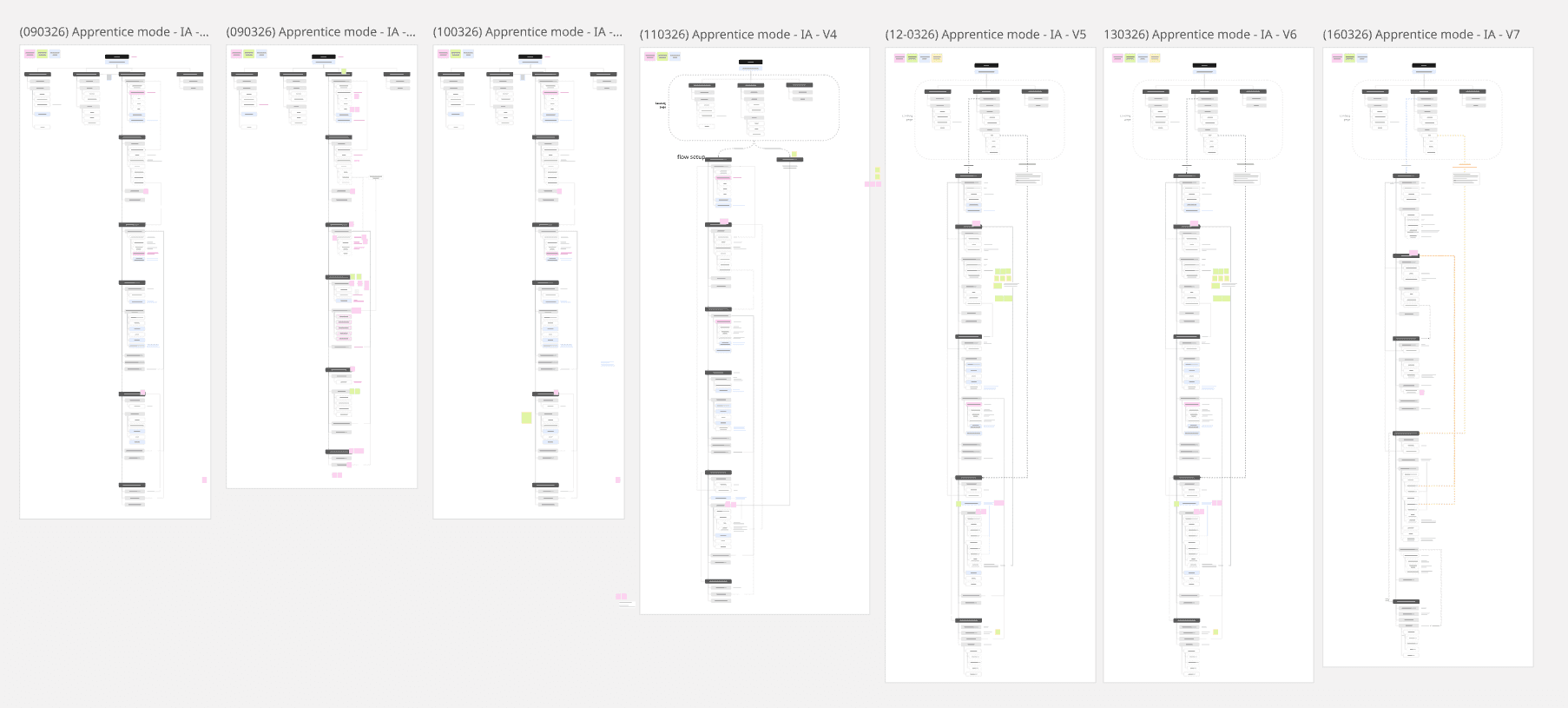
7 IA iterations enabled development kickoff within 2 weeks.
③ How does the system fit together? → Information architecture
When asked for UI concepts within a week, I prioritised Information Architecture instead.
What I found
The team had different mental models of agents, roles, and system boundaries.
My decision
When asked for UI concepts within a week, I proposed aligning the IA first.
Impact
7 IA iterations aligned the team and enabled development kickoff within 2 weeks.
Outcome
Established the foundation for the full Execution → Learning lifecycle
Established the foundation for the full Execution → Learning lifecycle
Execution Mode was about designing trust while AI works. Apprentice Mode is about designing how users teach AI. Together, they form a complete lifecycle: A person teaches. The agent learns. They work together.
Execution Mode was about designing trust while AI works. Apprentice Mode is about designing how users teach AI. Together, they form a complete lifecycle: A person teaches. The agent learns. They work together.
Product outcome (In progress)
Product outcome (In progress)
Interaction model defined
Development kickoff enabled
Interaction model defined
Development kickoff enabled
Pilot planned for Q4 2026
Execution → Learning loop established
Pilot planned for Q4 2026
Execution → Learning loop established